

Category
Data Sources
Product Version
7.3

How to Provide where clause condition in Sql Query of a View
Answered
Hi Yellow Fin Team,
How can we specify a where clause condition while creating a View.
If you click on Model Tab of a View, will see all the Tables with there relations, Click on Table settings, we can make use of conditions but this is used only for particular Table not for the entire SQL statement.
Scenario : I have Table with status as Priority 1 (5 Records), Priority 2 (5 Records) and some data with Null (5 Records), The data with null value should be updated to Priority 2.
So when i make count while processing report it should show
Priority 1 (5 Records), Priority 2 (10 Records)
But its not possible directly if i use and Calculated fields then also its not able to sum.
Kindly required your help
Thank You.
Files:
Incident.png
 The same question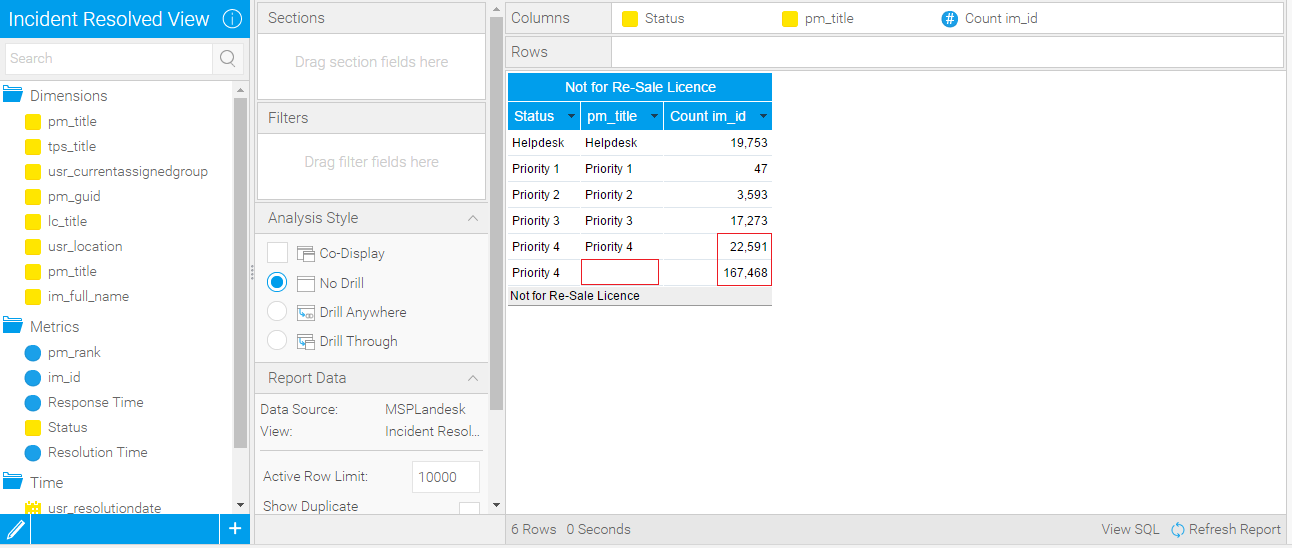
Hi Sairamreddy,
Unfortunately I am a bit confused as to what you are looking for here. Would you be interested in scheduling a time to screen-share? If so, please let me know what time works best for you. I am on United States Mountain Time.
Regards,
Nathan
Hi Sairamreddy,
Unfortunately I am a bit confused as to what you are looking for here. Would you be interested in scheduling a time to screen-share? If so, please let me know what time works best for you. I am on United States Mountain Time.
Regards,
Nathan
Hi Sairam,
Applying a where clause in the view query depends highly on what you are trying to achieve, what exactly would you like to filter on through this clause?
Typically the best way to apply filters over the entire view is to employ access filters which allow you to limit data by what user/client organization is accessing the data. http://wiki.yellowfin.com.au/display/USER73/Access+Filters
Other than this, your best bet will be to apply these filters at the report level.
From my understanding the "null values" and "where clause" are separate issues, can you please elaborate a bit on this?
Regards,
Nathan
Hi Sairam,
Applying a where clause in the view query depends highly on what you are trying to achieve, what exactly would you like to filter on through this clause?
Typically the best way to apply filters over the entire view is to employ access filters which allow you to limit data by what user/client organization is accessing the data. http://wiki.yellowfin.com.au/display/USER73/Access+Filters
Other than this, your best bet will be to apply these filters at the report level.
From my understanding the "null values" and "where clause" are separate issues, can you please elaborate a bit on this?
Regards,
Nathan
Hi Sairam,
Have you had any luck in resolving this?
One additional thought here is to employ filter groups, which make the application of common filters far simpler than creating them for each report. Please let me know if there is anything I can do to help here.
Regards,
Nathan
Hi Sairam,
Have you had any luck in resolving this?
One additional thought here is to employ filter groups, which make the application of common filters far simpler than creating them for each report. Please let me know if there is anything I can do to help here.
Regards,
Nathan
Hi Sairam,
I am going to set this ticket to closed for now, but if there is anything else I can do to help here, please just let me know and the case will be re-opened!
Regards,
Nathan
Hi Sairam,
I am going to set this ticket to closed for now, but if there is anything else I can do to help here, please just let me know and the case will be re-opened!
Regards,
Nathan
Replies have been locked on this page!